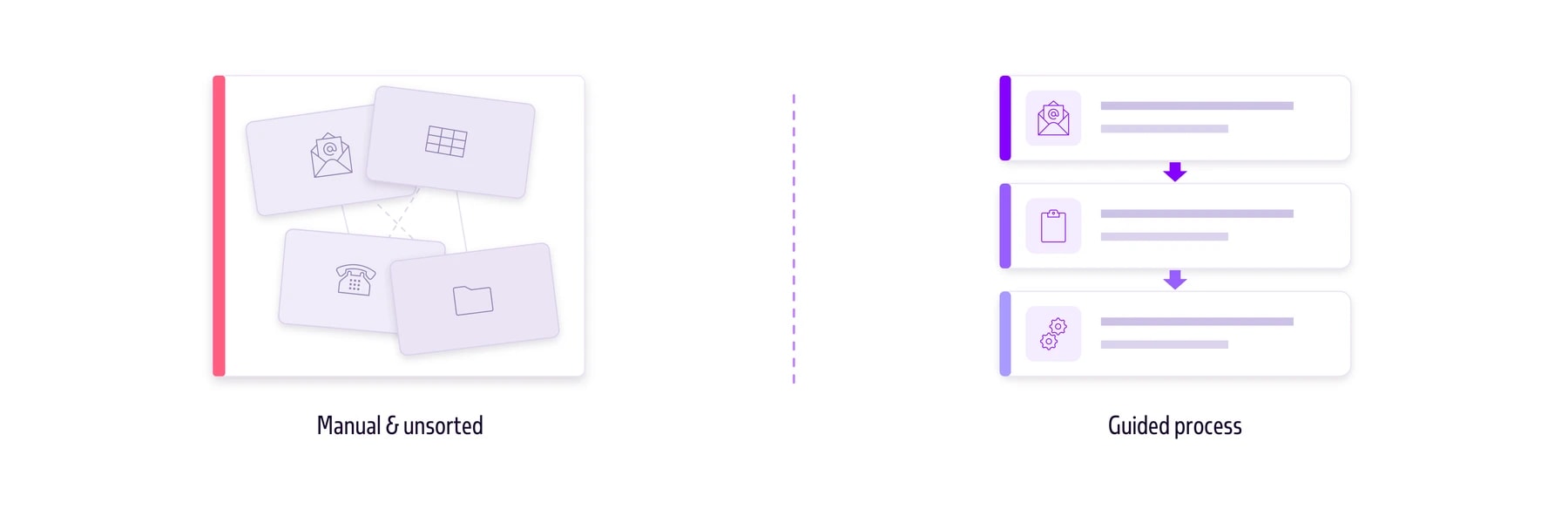
Why the material-creation process has become an underestimated efficiency killer in many German SAP landscapes, and why SAP Build Process Automation is the right answer to it.

At first glance, the process looks simple: create the material, maintain the views, release it. But anyone who takes a closer look almost always finds the same bottlenecks.
1. Distributed responsibilities
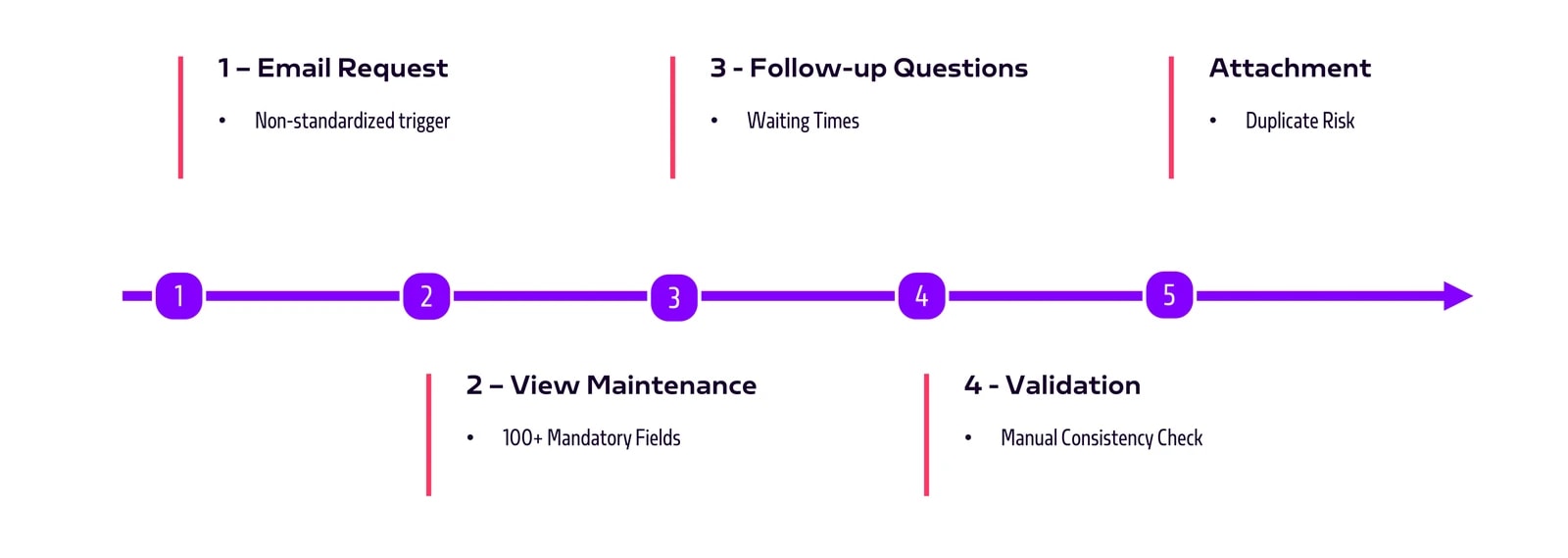
A complete material master in S/4HANA comprises well over 100 mandatory fields, depending on material type and configuration, spread across more than a dozen views: basic data, sales, MRP, accounting, plant data, storage locations, classification. These fields belong organizationally in different hands: master data, MRP/planning, controlling, sales, purchasing. Every handover between these responsibilities is a potential break in the process.
2. No common trigger
A sales colleague writes an email, a planner makes a phone call, an Excel sheet lands in the inbox. The trigger is rarely standardized, and therefore neither is the process.
3. Manual validation
Does the material already exist? Is the proposed plant and valuation configuration consistent? Do the unit of measure and language settings match? Today these checks often happen in the heads of the master-data owners, and as volumes rise they increasingly become a source of error.
4. Duplicates and inconsistencies
When three plants create materials independently of one another, duplicates quickly arise, with all the consequences for planning, reporting, and later consolidation.
That this process is not an isolated problem is shown by real-world experience: SAP customers regularly report more than 1,000 manual working hours per year going into material creation alone.
SAP Build Process Automation (BPA) is SAP's official low-code automation platform, hosted on the SAP Business Technology Platform (BTP). It combines four building blocks made precisely for processes like this one:
Strategically, BPA fits exactly into what SAP itself has been demanding for years as its mandatory architectural approach: Clean Core with side-by-side extensions. Enhancements are no longer placed in the core as Z-code, but live as decoupled applications on the BTP. This keeps the S/4HANA system upgrade-capable and positions you to connect to the AI wave that SAP is currently establishing in the market via Joule and Joule Studio.
The DSAG Investment Report 2026 confirms this direction: with 39 percent of planned high and medium investments, BTP is the most important solution in the SAP portfolio. For application development and automation on BTP, 27 percent of DACH companies are planning corresponding budgets, a clear increase over the 17 percent of two years ago.
In other words: BPA is not the next trend pitch. It is the path SAP customer organizations are going to take anyway.
Theory is good, practice is better. What happens when you apply BPA to the material-creation process?
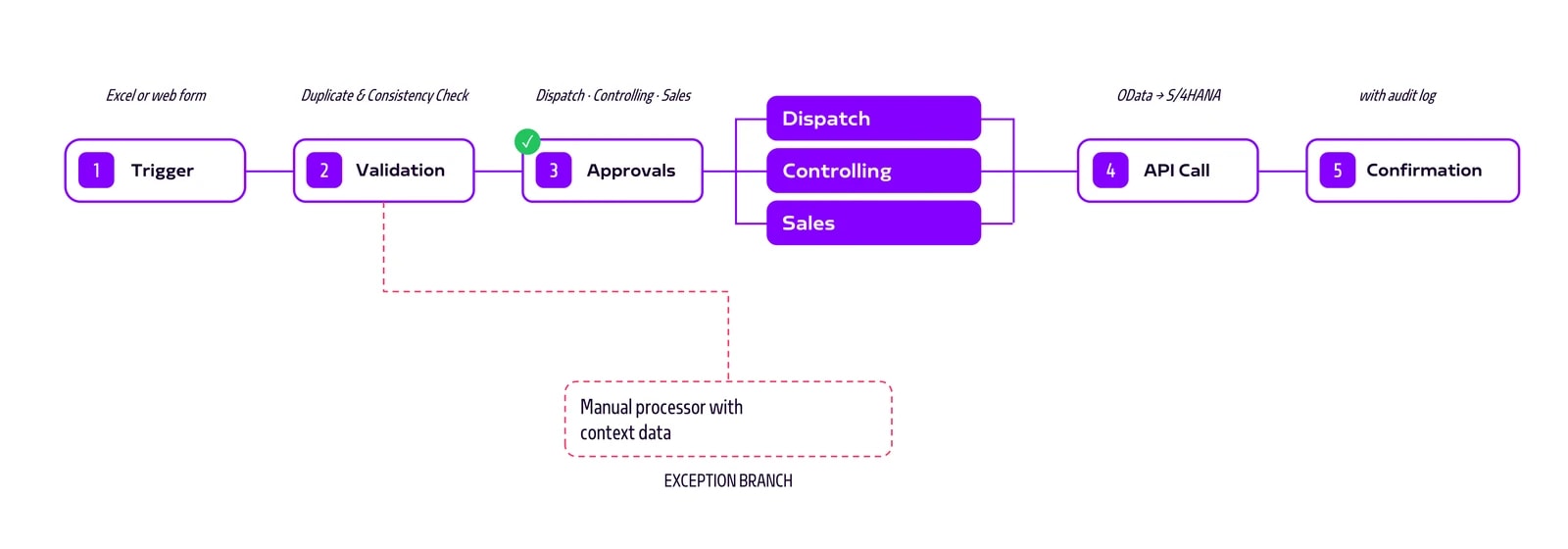
Standardized entry point. Instead of emails and phone calls, there is a digital form or an Excel upload. Requests enter the system in structured form, with all mandatory fields and an initial validation.
Automated pre-check. The workflow immediately checks: Does the material already exist? Are the plant, valuation, and sales configurations consistent? Do the units of measure match the language maintenance? What previously meant hours of manual research now happens in seconds.
Multi-stage approval. Planning, controlling, and sales receive their tasks in parallel or sequentially, with clear responsibility, escalation paths, and SLA monitoring.
Creation via standard APIs. BPA creates the material through the official OData services (API_PRODUCT_SRV or the more modern v4 variant API_PRODUCT_2) in S/4HANA. No Z-code, no modification to the core, fully Clean-Core compliant.
End-to-end traceability. Every step is documented: request, validation, approval, and creation. Audit-ready, without Excel lists.
Exception handling. Anything that cannot be unambiguously automated, such as new classifications or special cases, lands cleanly with a human processor, complete with all the context.
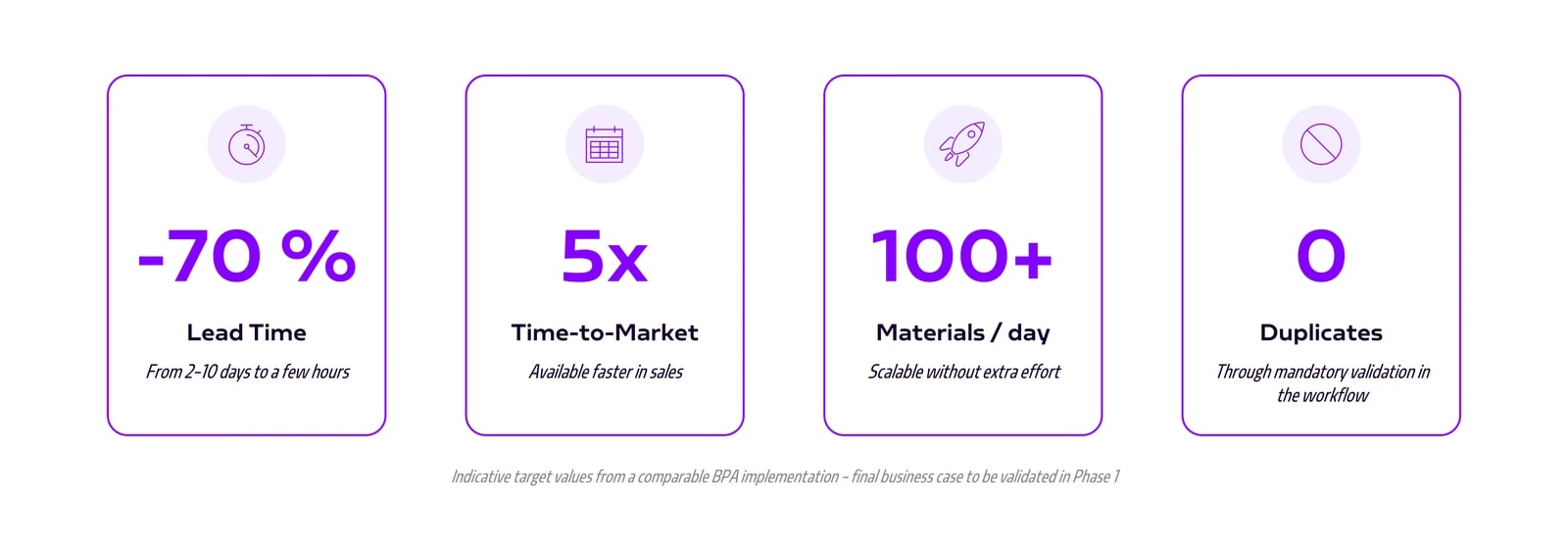
The most reliable figures come from real implementations at mid-sized companies and large enterprises. A typical picture:
Important: these numbers don't appear overnight. They are the result of a structured approach. And this is precisely where many BPA projects that are tackled without specific SAP know-how fail. BPA is powerful, but it does not replace domain expertise. Anyone who doesn't know the pitfalls of the OData interfaces, the view management in S/4HANA, or the field logic will quickly build a workflow that works in 80% of cases, and it's exactly the missing 20% that makes the difference between a nice demo and a productive system.
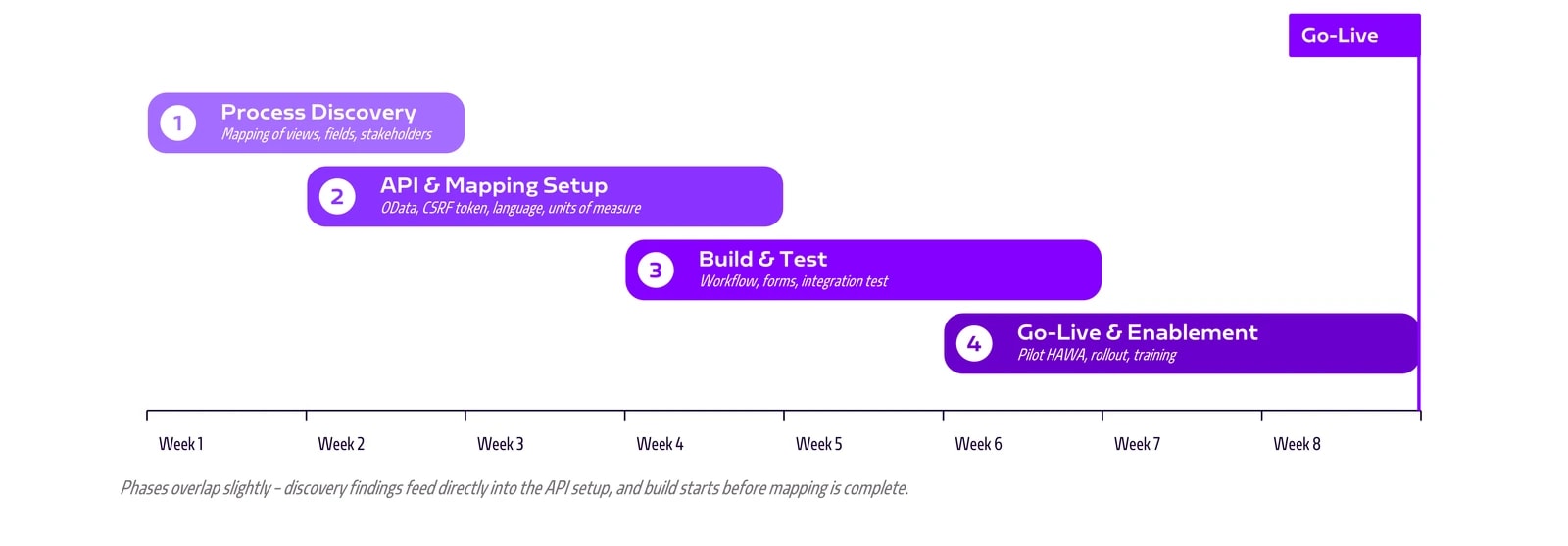
From our project experience, an approach has proven itself that goes live in 4 to 8 weeks:
Weeks 1 to 2: Process Discovery. We analyze your actual material-creation process. Which views? Which mandatory fields per material type? Who is involved? What are the most common sources of error? Result: a complete mapping of all relevant fields, views, and stakeholders.
Weeks 2 to 4: API and Mapping Setup. We configure the OData connection to your S/4HANA system, usually via API_PRODUCT_SRV or, in greenfield scenarios, via API_PRODUCT_2 (OData v4). CSRF tokens, language handling, field values, and parameters are cleanly aligned.
Weeks 4 to 6: Build and Test. Workflow, forms, approval logic, and automated creation are built. In parallel, integration tests run against your Q system.
Weeks 6 to 8: Go-Live and Enablement. Pilot with selected participants and training of key users and administrators for a clean handover to the customer.
So that you have an honest assessment:
BPA fits very well when:
BPA is not the right tool when:
A good indicator: if you can sketch your process on a whiteboard in an hour and more than two people carry out different steps in it, BPA is very likely the right lever.
Today is a good time to get started with SAP Build Process Automation:
The Clean-Core pressure is rising. With legacy systems being phased out and SAP's new Clean-Core concept, side-by-side architecture is becoming mandatory.
BTP investments are growing. The DSAG survey clearly named application development and automation on BTP as an investment area.
The AI layer is coming. Joule, Joule Studio, and the Agent Builder are built on the same BTP architecture that BPA uses. Whoever automates cleanly today is AI-ready tomorrow.
Material creation is one of the best entry-point use cases here: high volume, clear rules, measurable ROI, low risk, and a pain point everyone in the company knows.
At ORAI, we specialize in exactly these topics: SAP depth meets BPA and BTP expertise. We know the pitfalls of the material OData APIs, we know which views must be maintained in which order, and we bring your first productive use case across the finish line in four to eight weeks.
Book a call
We walk through your current process and tell you where the time goes and which use case delivers the fastest return for you.
Send us a note or book a short meeting.
